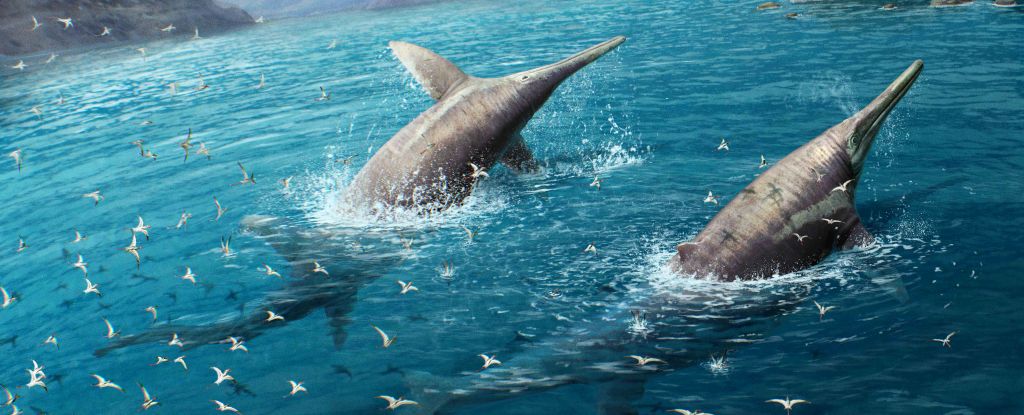
Triassic Terror: Ichthyotitan Severnensis, The Ancient Ocean's Killer Whale
Imagine a world teeming with colossal creatures, where the oceans were ruled by giants unlike anything we know today. For millions of years, the deep, dark waters of the Triassic period held a secret, a testament to evolution's incredible power. Now, thanks to an extraordinary series of discoveries, that secret has swum into the light:
Ichthyotitan severnensis, a marine reptile so immense it dwarfs many modern whales, earning it the moniker "the ancient ocean's killer whale." This monumental
Ichthyotitan Severnensis Discovery not only rewrites our understanding of prehistoric marine life but also highlights the invaluable contributions of citizen science.
The Spark of Discovery: How a Young Eye Unveiled a Giant
The story of
Ichthyotitan severnensis begins not in a grand research lab, but on the muddy shores of Blue Anchor, Somerset, UK. In May 2020, amidst global lockdowns, 11-year-old Ruby Reynolds and her father, Justin, were engaged in a timeless pursuit: scanning the mudflats for fossils. Their keen eyes landed on an intriguing fragment, a piece of what would later be confirmed as part of a massive jawbone. Little did they know, this fragment would become a crucial puzzle piece in revealing the largest known ichthyosaur to ever swim Earth's oceans.
This wasn't the first hint of such a giant. The initial spark for the *Ichthyotitan Severnensis* discovery actually dates back to 2018, when fossil collector Paul de la Salle found another enormous jawbone piece along the same coastline. Paleontologist Dean Lomax, a leading expert on ichthyosaurs, examined de la Salle's find and expressed hope that more specimens would eventually come to light. Lomax's wish was granted in 2020 with Ruby and Justin's discovery. The second, better-preserved jaw piece allowed Lomax and his team to confirm that both colossal bones belonged to the same species, definitively identifying the new giant.
The formal naming of the creature,
Ichthyotitan severnensis, is a beautiful nod to both its awe-inspiring size and its place of discovery. "Ichthyotitan" literally translates to "fish titan," while "severnensis" refers to the River Severn Estuary, the region where these incredible fossils were unearthed. This collaborative journey, spanning years and involving both amateur enthusiasts and professional paleontologists, underscores the power of public involvement in scientific discovery. It's a vivid reminder that anyone, with a curious mind and a sharp eye, can contribute to unlocking the secrets of our planet's past.
An Ancient Leviathan: Unpacking Ichthyotitan's Immense Scale
With jawbone fossils measuring an astonishing six feet in length, paleontologists have been able to make remarkable estimations about
Ichthyotitan severnensis. The consensus suggests this incredible creature measured *more than 80 feet in length*, making it potentially the largest ichthyosaur ever discovered. To put that into perspective, this ancient marine reptile was comparable in size to a modern fin whale, cementing its place as one of the most colossal marine predators in Earth's history. The comparison to an orca, or "killer whale," isn't just about size; it speaks to its presumed ecological role as a dominant, apex predator in its ancient habitat.
However, scientists maintain a careful note of caution on the exact dimensions. To date,
Ichthyotitan severnensis is known from only two bones, both parts of the lower jaw called the surangular. While these fragments are undeniably enormous and indicative of an animal of immense scale, a complete skull or skeleton would provide even greater precision. The scientific process often involves extrapolation based on known relatives. If
Ichthyotitan had similar body proportions to other giant ichthyosaurs like
Shonisaurus, the 80-foot estimate holds strong.
The rarity of complete fossils for such large marine reptiles is not unusual. Paleontologists suggest it might be due to their ecology. Living in the open ocean, the bodies of these magnificent creatures would have been exposed to scavengers for longer after death, making intact preservation a challenge. In fact, at least one of the
Ichthyotitan jaws even shows signs of having been nibbled before its eventual burial and fossilization. This intriguing detail offers a glimpse into the fierce competition and scavenging that likely characterized the Triassic marine ecosystem. Despite the limited remains, the sheer scale suggested by these massive jaw fragments unequivocally establishes
Ichthyotitan severnensis as a true titan of the prehistoric seas.
Rewriting the Triassic Seas: Ecological Impact and Scientific Significance
The *Ichthyotitan Severnensis* discovery is more than just finding a big bone; it's about illuminating a previously dark corner of prehistoric life. The Triassic period, particularly the specific timeframe *Ichthyotitan* inhabited, has long been considered a "black box" for ichthyosaur evolution and diversity, especially concerning giant species. Before this find, most other known giant ichthyosaurs were discovered in older rock formations, primarily in North America and Asia. The emergence of
Ichthyotitan severnensis in the United Kingdom, from the tail end of the Triassic, fundamentally reshapes our understanding of these creatures' geographic distribution and evolutionary timeline. It strongly suggests that gigantism in ichthyosaurs was a more widespread and prolonged phenomenon than previously thought.
As an apex predator, an 80-foot-long
Ichthyotitan would have required a phenomenal amount of food. Its existence indicates a remarkably productive and diverse Triassic marine ecosystem capable of sustaining such immense creatures. While its exact diet remains speculative without more fossil evidence, its size and "killer whale" analogy suggest it hunted large prey, potentially other marine reptiles, large fish, or cephalopods. The presence of such supersized reptiles over tens of millions of years points to stable, food-rich oceans that allowed these magnificent predators to thrive.
The detailed scientific description of
Ichthyotitan severnensis, published in a 2024 paper, provides invaluable data for paleontologists. It offers a fresh picture of life in a part of the world and a time when such giants had not been found before. This discovery helps fill critical gaps in the fossil record, allowing scientists to piece together a more complete narrative of marine reptile evolution. It's truly a game-changer, demonstrating that our planet's ancient history still holds incredible surprises. For more insights into how this creature fundamentally alters our historical understanding, check out
Ichthyotitan Severnensis: New 80-Foot Giant Rewrites Marine Reptile History.
Beyond the Bones: The Future of Paleontology and Community Science
The journey of
Ichthyotitan severnensis is far from over. While the current jawbone fossils provide a tantalizing glimpse into its grandeur, scientists eagerly await further discoveries. More fossils, perhaps even a complete skull or sections of the vertebral column, would allow paleontologists to:
*
Refine Size Estimates: Pinpoint the exact dimensions and body proportions with greater accuracy.
*
Uncover Unique Features: Discover how
Ichthyotitan differed from other ichthyosaurs in its skeletal structure and potential adaptations.
*
Understand Its Lifestyle: Gain deeper insights into its swimming mechanics, hunting strategies, and ecological niche.
The incredible story of Ruby Reynolds and Paul de la Salle serves as a powerful testament to the ongoing importance of citizen science. Practical tips for aspiring fossil hunters include:
*
Know Your Local Geology: Research areas known for fossils, like coastal cliffs or quarries, always checking for safe access and local regulations.
*
Be Patient and Observant: Fossil hunting requires a keen eye and persistence. Not every outing yields a major find.
*
Respect the Environment: Collect responsibly. If you find something significant, especially on protected land, report it to local museums or geological societies. They can ensure proper excavation and preservation.
*
Document Everything: Take photos and note the precise location of any find. This data is crucial for scientific context.
The
Ichthyotitan Severnensis discovery reminds us that the Earth continues to hold untold stories beneath its surface. With luck and continued exploration, both by dedicated professionals and enthusiastic amateurs, future discoveries will continue to fill out the form of this magnificent Triassic terror, further enriching our understanding of life's incredible past.
Conclusion
The *Ichthyotitan Severnensis* discovery is a triumph of paleontology, a compelling narrative woven from ancient bones, scientific dedication, and the serendipitous find of an 11-year-old girl. This colossal marine reptile, truly the ancient ocean's killer whale, has burst from the depths of the Triassic "black box" to redefine our understanding of prehistoric marine ecosystems and the evolution of gigantism. Its immense size, estimated at over 80 feet, firmly establishes it as the largest known ichthyosaur, challenging previous assumptions about when and where such titans roamed. As scientists continue to unravel the mysteries held within these magnificent fossils, one thing is certain: the story of *Ichthyotitan severnensis* is a powerful reminder of the endless wonders hidden within our planet's history, inspiring both current and future generations to keep searching, questioning, and discovering.